About Me

My photo
A college created blog that shall follow all the courses I undertake on my apprenticeship. Comical, and terribly cringe-worthy mishaps are inevitable.

Tuesday, 26 July 2011

Unit 6, 2 and 2.1 - Video Production

For our DiVA Viral Marketing Campaign, in a short amount of time, we went through the stages of Pre, Post, and the Production itself to create our Viral Marketing Video.

Here are some of the stages we underwent...

A group 'Mind Map' on what apprentices do.
.
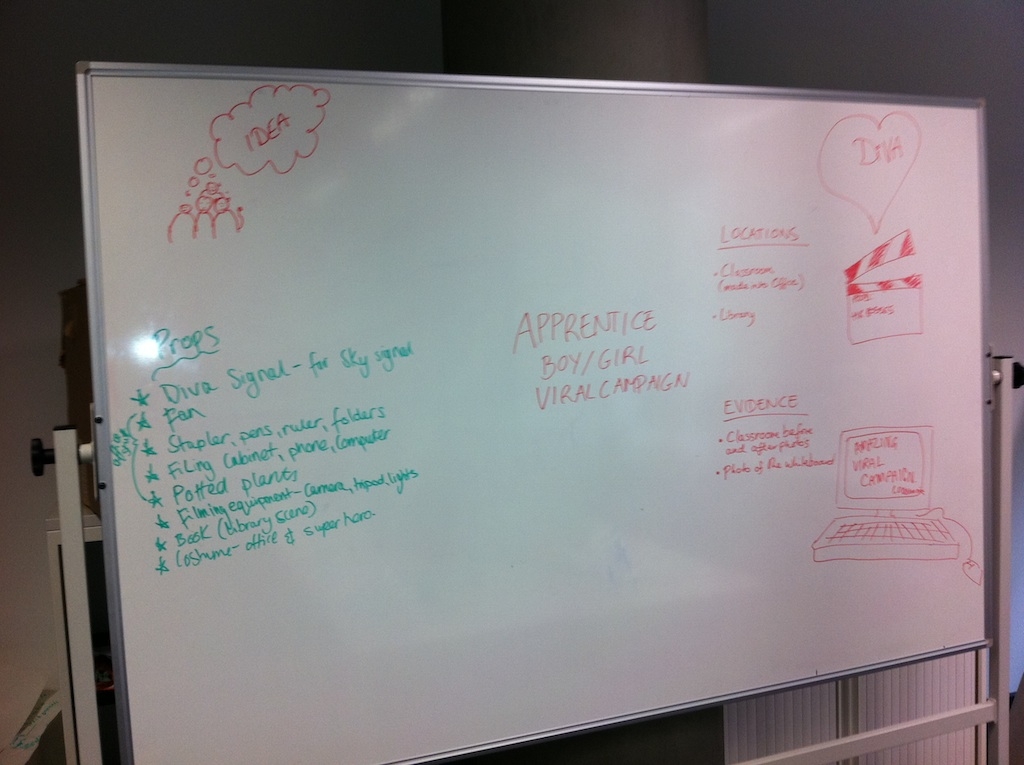
The Whiteboard that Joy and I wrote out

Robert's designs for the Apprentice Man.
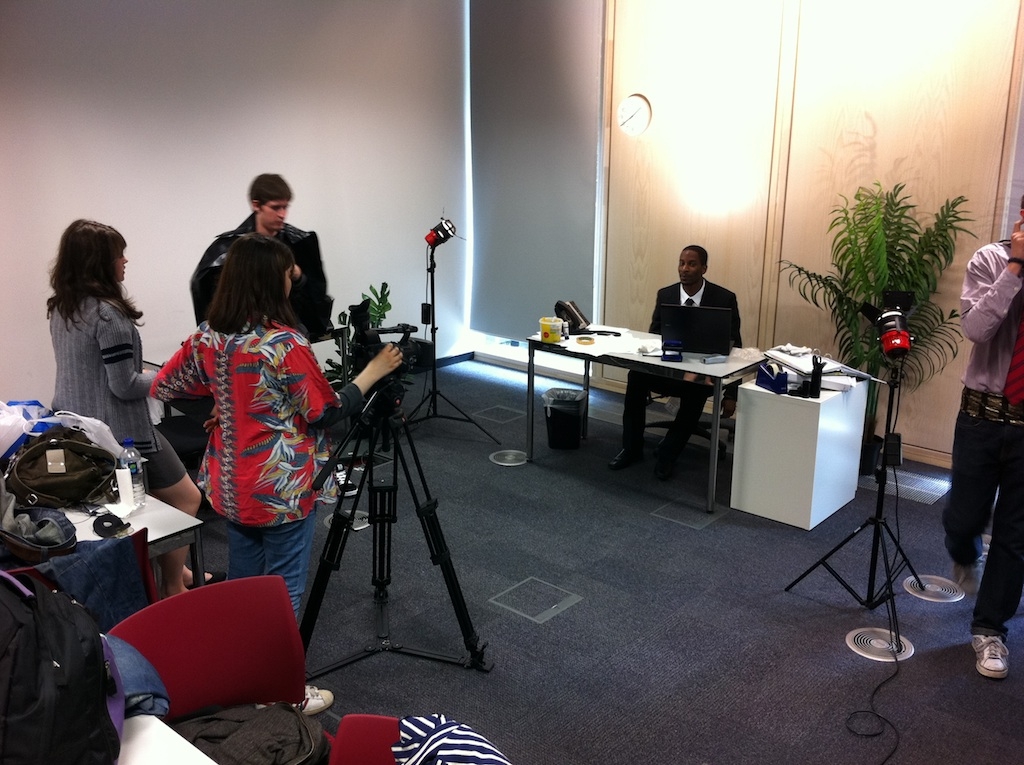
The DiVA Viral Marketing Campaign crew, with me on Camera.
Some of the team, including myself, editing away.

I was able to both contribute in a technical capacity and undertake a technical role in the creation of a video product, by being set a number of different jobs within the filming and post, such as working on camera and also editing. 

As camera operator on the shoot, I conversed with our assigned director, Robert, on how to frame each of the shots - what would work best, etc.- most of which the final video product was filmed by myself. 

While on camera, I was also in charge of sound, making sure that our actors were heard at all times, otherwise the scenes would have to be re-shot in order for the sound to sync in with the visuals. 

On top of being the main-go to person for the sound on set, I - along with fellow classmate Deri - sourced out plenty of free copyright sounds online to add to the video, which were included in the final product to create more of a professional affect. 

As for editing, the whole team took turns to splice up all the footage, and make it into a smooth running video. We conversed with one another as separate people took on the editing role, to make sure that we were all heading in the right direction.

I also assisted in setting up the lighting for wherever we were intending to film, understanding that, if the lighting in a shot was off, we would have to either convert it in post or re-take the shot, which would have pushed us back further from our deadline. 

Tuesday, 19 July 2011

The National Theatre Trip


Visiting The National Theatre a few weeks back was a really great experience. Not only did me and my classmates get to go on a behind-the-scenes tour and speak to employees at the theatre, but we got to watch two first-night plays which definitely sparked discussion in the group.

After a half-day at college, we jetted off to The National Theatre and set about meeting the Digital Department who run, as you can tell from the name, the digital side of the theatre . From there, we sat down and had a great, lenghtly discussion about what The National Theatre do, how they are trying to move into the Digital Age, and more, which was extremely insightful for someone who doesn't know too much about how a theatre operates. 

After this talk, our group then joined a school trip and had a great inside tour from Katherine, our tour guide. What was most impressive about the tour was something I didn't expect to love so much, and that was the workshop. To see all the goings-on on the set building side of the theatre was great, and something I really enjoyed learning about.

Our day ended with the performances of two plays from the Connection series: Frank and Ferdinand, and Children of Killers.

First up, we had, what in my eyes, was the weaker play - Frank and Ferdinand.

Though I am a fan of things that I can't explain (David Lynch is one of my favourite artists), Frank and Ferdinand, to me, was all over the place. There were glimmers of hope - for example the actress that played Sarah was great -, but the rest was quite a struggle for me as a viewer to get through and I still can't understand what the play was trying to get at; what it was about.

The staging proved another problem to me. Though it was definitely original, I think it didn't work for what the play was trying to get at.
Even through the weaker points, I still found myself laughing a few times, though I thought the play as a whole wasn't for me.
The young cast of Children of Killers

The second and last play of the day was Children of Killers. Now, like with Frank and Ferdinand, there were problems, but this was the play out of the two that I enjoyed the most and connected to. The staging was wonderful here, and was definitely the strongest point of the production. The rape scene was played out superbly, and definitely had me feeling uncomfortable. Yes, there were hiccups in the acting (I found it hard to connect with the lead actor in particular), but it was a much better play than Frank and Ferdinand, previously. Especially in the writing.

What was great about seeing these two plays, though,  is that I had a surgance of writing inspiration hit me. As someone who wants to write for a living, working at my placement at the moment, I have begun to realise that though I love film, I love writing more, and this is the avenue I want to explore - whether that be with comics, short stories, or scripts, I want to have my finger in every pie, as the saying goes. In my eyes, having that surgance of writing is always a price I am willing to pay, and I am thoroughly glad I went to see the two plays.

They were no Sucker Punch - a play I can speak about until the cows come home -, that is true, but both plays were gallant efforts, and gave me more than I could have asked for, (writing inspiration!). 

Overall, it was a really good experience visiting The National Theatre, a place which I really enjoyed when I went to see FELA! a few months back, and one that I now know I will definitely be revisiting in the future. (And maybe for a work experience placement!)

5 Websites I Visit

A magazine that I buy biannually (it is released every two months), Little White Lies is a great pop-culture infused film-fest with whip-smart reviews and smartly written articles, focusing on everything and anything to do with film.

One of the many themed issues of LWL's
Each issue focuses on a particular film being released the month the magazine is published, (for their most recent issue, The Skin I Live in is put on the operating table for a good dissection, featuring an interview from Director Pedro Almodovar.)

What is great about Little White Lies, though, is that if you don’t want to fork out a couple of quid to buy the issue when it is published, or it has sold out, a digital issue of the magazine will be printed on their website (for free!) a month after the physical edition has been released. This is a great interactive way to keep up with the Digital Age, and something that very few, if any, magazines have adopted.

Keeping in line with their smartly made magazines, Little White Lies’ website is yet another hub for film lovers everywhere; a real treat.

You can participate in film-chit chat on the Little White Lies blog where you are free to discuss reviews, cast and crew interviews, and much more. There is a great shop where you can buy the latest addition of the magazine, badges, or postcards of magazine covers – basically, it is a great website filled with everything a film fan could want.

The Film Experience, which started out as a Blogspot page and now has a .net URL, is one of the most followed film-related blogs on the internet.

Mostly based around Award seasons (in particular the Oscars), The Film Experience works in your usual review-a-film blog schitck, but adds frequent interesting and quirky articles into the mix such as the Best Shot series, where Nathaniel (the writer of The Film Experience), asks his readers to pick out the best shot of a certain film. Here, Nathaniel looks at A Streetcar Named Desire, a wonderful film that everyone should watch.

Tilda Swinton on the cover of D&C
Going back to magazines that I purchased, Dazed and Confused’s website is a great source for all things art-based. Though Dazed and Confused is a fashion magazine, they span all things arty – ranging from exhibitions, to books, music and film – both in magazine and online format.

Out of all the websites and blogs I browse through, Dazed and Confused’s website is visually the most unusual, fitting nicely into their art-based focus as a magazine. 

The downside to Dazed and Confused’s website is it’s interaction is limited to those that use Facebook and Twitter. Yes, the majority of internet users have a Facebook or Twitter account (and in a lot of cases, both), but for someone like me, who has neither accounts, it discriminates me from communicating with those that love Dazed and Confused as much as I do because I don’t get the option to comment in a normal blog factor.

This is a downside to the cheekily written Ultra Culture, too. Fronted by Charlie Lyne – a twenty year old blogger – Ultra Culture has now gained notoriety for being featured on BBC’s Film 2011, and taking no prisoners when he gets on the keyboard to writing.

Like with Dazed and Confused, Ultra Culture doesn’t have a comment system for the Ordinary Joe. Instead, to enter competitions on the site, you have to have a Facebook account to comment.

Lastly, we have teen-run The F Bomb, a site written by teenagers for the feminist community. (I have written posts for the site before, which was great!)

A mixture of fictional writings and articles, The F Bomb is a wonderful site for teenage feminists to find a voice; to speak about how popular culture - including the media 0 is affecting their lives, wherever they are in the world.  

So, those are my must-to destinations on the World Wide Web, what are yours?

My Digital Life

This is obviously not me, but you get the idea.
Since the age of 8, there has always been a computer in my household. Before there were computers in my Primary School, I became equipped to knowing the basics that, at the time, seemed pretty professional (ranging from knowing what LOL meant, to Ctrl-Alt-Del.)

As any other person with computer access, I use my laptop daily. Mostly, when I have a spurge of inspiration, it is used for writing. When it concerns writing, I find when I have hit an idea, that if I am typing it down rather than using a pen and paper, I can get my jumbled thoughts out a lot more quickly, and with more coherence than if I resorted to the pen and paper method.

I am one in a million (quite literally) when it comes to not having a Facebook and Twitter account.  Though I am now managing my work places’ Facebook and Twitter; tweeting and status-updating on various things going on with the film they are shooting, I don’t have my own personal accounts. Why? Because, apart from a business aspect, I don’t feel I need them on a personal level. At some point, when promoting my freelance work, I know I will have to jump on board the fad and get myself out there, but for now, I am content with writing various articles for websites when I get the time, and running my blog which I started up in May, Feminising Film.

I am not a novice when it comes to communicating digitally with friends, family, and potential colleagues, though. From emailing Literary Agents with chapters of my book, in hope that they will represent me, to messaging friends and family, these are some of the many digital communication systems out there that I use.And of course I couldn't forget my trusty Blackberry.
 

Monday, 27 June 2011

DIY Communication: Why I opted for making a zine

For our college unit relating to Communication, I opted for doing something that was perhaps a little outside of the box (as I had spoken about in a previous blog post) and make a zine.

At first, I wanted to work around the way the media portray certain people, social networking, and advertising, but as I moved along with the project, I realised that I was taking to much on board, and instead, it would work a lot better for the point I was trying to get across about certain media manipulation if I focused on one particular topic – ‘celebrities’.

Celebrities and the celebrity culture has always been foreign to me because I have never gotten the attraction of heaping praise on someone that you don’t know, and viewing them as a kind of idol (even to the extent a Godly figure.)

This is something I am going to speak about in another topic, but I’ll give a brief outline of what’s to come before I speak more about my intention with my zine.

My fellow college students and I, have been given two separate industry sectors to speak about (all within Digital Media, of course). We have to speak, or present, these topics in the way that we feel most comfortable (mine is going to be a detailed blog post, that mostly reads like an essay, but is fed with a series of images, and video clips to add to the Digital aspect of the work). Through speaking about our two chosen industries, we will naturally end up talking about those that we weren’t assigned, which will lead into our understanding of the Digital Media Industry and how it works; how it combines everything from Film to Graphic Design.

You’ll have to wait until my next post to see what two industries I picked, but before I get sidetracked, back to the zine.

The reason I opted for a 90s style of communication, one where it required me to collage my work onto paper, scan the glued paper carefully onto, new, separate sheets so that I wouldn’t ruin the format, and then staple the work together with a special magazine stapler, is because, I believe, it showed a complete opposite to the tech savvy world we live in.

By using a hands-on medium, I think I have made something that has more of an impact than if it had been totally digital.

It’s a statement to the polar opposite of the world we live in now. Speaking about something that is so heavily digital based, so heavily media based, but through a DIY process.

As a society, we ignore anything that isn’t fast, quick, and gets to the point – we like everything to be in the palm of our hand and this tool of communication is the complete opposite.

Pictures to follow of the zine shortly.

Friday, 10 June 2011

The Art of Negotiation

Negotiating is something that we all have to do in life, and, in some cases, it is a craft.  We do it subconsciously, but a lot of the time, to get the better deal, we do it consciously. While we want something out of negotiating whatever it may be, we always have to think about the recipient or the recipients, and what they are going to get out of the negotiation. It is a skill that we pick up from an early age, but one that takes a considerable amount of time to hone into something that can take us to all the places we want to be in life. 

Let’s single negotiating out to working in your place of work, and how it is needed to step up in the ladder of whatever profession you choose.

To get where you need to go, negotiating is not just a tad helpful, but it is a required tool. No matter the work place you reside in, and who you are intending to negotiate with, it can be what makes or breaks your career. Especially since it is linked with communication.

If you can’t communicate yourself well enough when trying to get what you require, then taking this communication to the next step where you are negotiating something important is useless. You won’t be able to get what you want out the negotiation and nor will the person you are trying to sway into whatever scenario it is.  

Say that the situation is a really important one like trying to sell something to a would-be business partner. Without a clear route of communication (which could be through a presentation, emailing, or just talking) what could end up as being an excellent money making deal could fall flat on its face because of how this negotiation is communicated. You need to show the pros and cons of what the would-be business partner is buying into, otherwise, they are just not going to buy into it. 

This is one of the many reasons why negotiation can get you to places you may have not been able to go without it. It can be simple 'negotiating' with family for the last bag of sweets, or it can be broad; one that jumps over to the work place where you have to step up your game if you want to further your chosen career. 

And there you have it, a scenario of negotiation and why it is a must-have skill. 

Friday, 20 May 2011

On communcation...

Communicating to others and to the public has drastically changed over the years. From word-of-mouth to social networking, somehow, information will be spread regardless of wherever you are in the world. There isn't any escape from it. TV, Newspapers, The Internet - it is all so prominent in our day to day lives that we barely bat an eyelash at it.

The ridiculously rapid rise in technology has shaped the way we communicate with one other. For the better, that is uncertain - ways of communication always has it's good and bad points, just like everything - but we can't deny that the usage of Twitter, Facebook and the like have changed how we speak to one another,

To represent communication in completely different formats, I have decided to create two parallels of how communication is fed to us. I have decided to go all out and make my own magazine. Yes, you heard right. I shall publish the magazine online via Issuu in it's online format, but it shall begin in a collage fashion in the form of a zine before making it's way up online.

What is a zine? Well, a zine is essentially a self-published magazine, hence the shortened name. Popularised in the 90s (and a key header for the Riot Grrl movement), zines were the place to go to if you wanted to get a message across, while creating something artistic and giving yourself and others a voice that may have not been heard from major media outlets.

Zines could be of anything and everything, and it's still a way to get heard - through self publishing.

Though it is perhaps not as DIY as the heydays of the zine in the 90s, it is still a valuable way of communicating, particularly with comics.

More on this one later.